
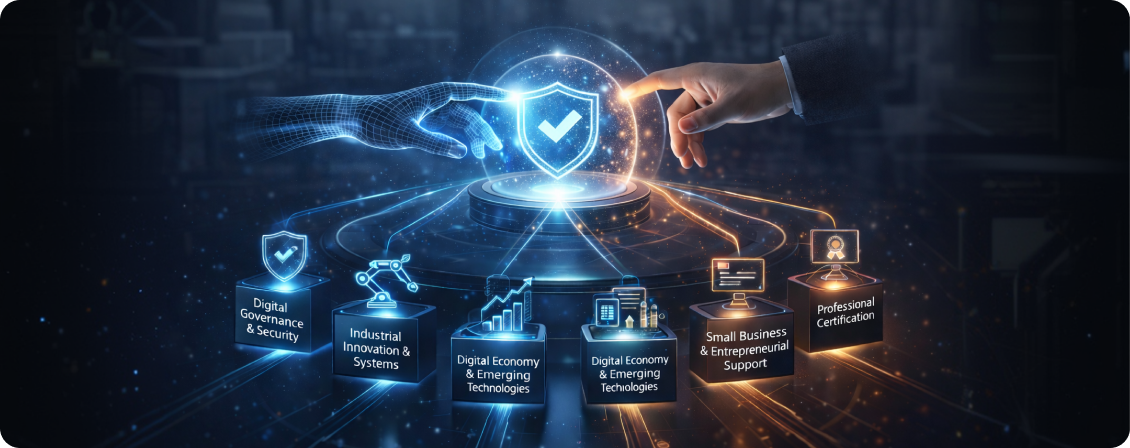
Digital assets are entering a new phase of maturity. What began as period of experimentation is now giving way to applied models that must operate within institutional, industrial, and regulatory environments. As organizations confront the realities of digital coordination, capital formation, and shared ownership, the most pressing question is no longer whether digital assets can work. The question is who can deploy them responsibly, at scale, and in ways that integrate with the real economy .
The evolution of the National DigiFoundry (NDF) into the Institute for Digital Assets & Innovation (IDAI) reflects this shift. NDF demonstrated that decentralized communities could assemble expertise, test governance concepts, and explore new economic models. Yet as projects moved closer to implementation, it became clear that experimentation alone could not meet the demands of governments, enterprises, and institutional partners. These stakeholders require clarity, standards, auditability, and long-term operational capability. IDAI was established to meet this need by focusing on execution and real-world deployment.
IDAI is structured as a think-and-do institute designed to connect research with implementation. Its work is organized through five Centers that together address the full lifecycle of digital asset adoption. The Center for Digital Governance & Security focuses on the trust foundation required for digital asset systems. Its work spans cybersecurity, regulatory alignment, and standards development. Without strong governance, tokenization fragments and fails to scale. The Center ensures that digital asset infrastructure can satisfy institutional requirements for resiliency and accountability.
The Center for Industrial Innovation & Systems grounds tokenization in operational reality. Many tokenized assets represent complex physical systems, including manufacturing assets, advanced infrastructure, and emerging space technologies. This Center ensures that tokenized models align with real engineering processes, supply chains, and asset lifecycles. It connects digital assets to the systems they represent, which is essential for reliable deployment.
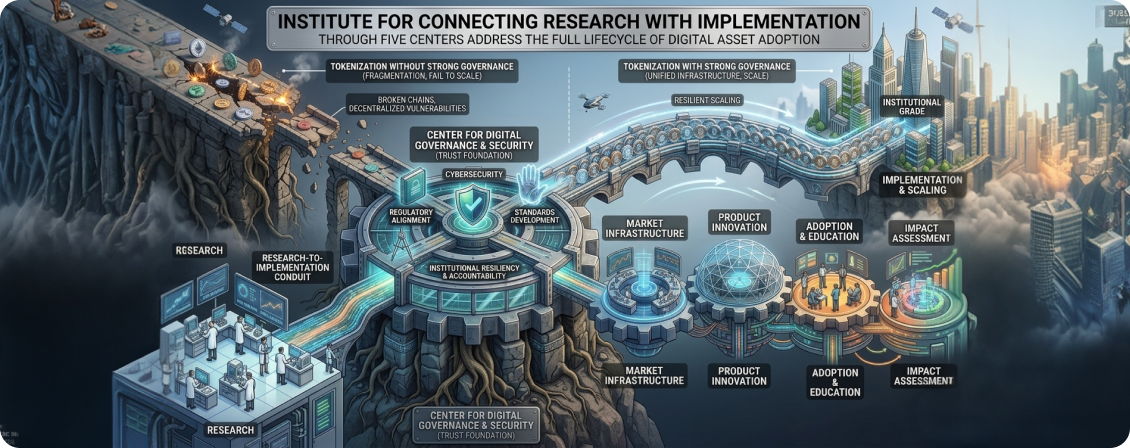
The Center for Digital Economy & Emerging Technologies designs the economic architecture of digital asset systems. This includes digital finance, incentive structures, market infrastructure, and responsible integration of AI. The Center ensures that rights, obligations, and value flows are encoded correctly and can interoperate with traditional financial systems. The Center for Small Business & Entrepreneurial Support focuses on early-stage organizations, where initial decisions about governance and token design can shape long-term strategic options. It provides guidance on capital readiness, regulatory awareness, and digital asset architecture.
The final component, the Center for Professional Certification, addresses workforce capacity. Widespread adoption requires professionals who understand both digital assets and the systems they operate within. Through standards-based education and certification, the Center builds the human capital necessary for responsible implementation across sectors.
Together, these Centers form an integrated framework that supports IDAI’s Real-World Asset (RWA) Tokenization Initiative. RWA tokenization is often misunderstood as a technical exercise. In reality, it is an economic redesign that modernizes how capital is formed, governed, and shared. Equity, debt, and contractual claims have always been forms of tokenization. Blockchain simply makes these structures programmable, transparent, and interoperable.
The demand for tokenization is growing because existing systems are strained. Friction in settlement, opacity in ownership, fragmented incentives, and barriers to capital access continue to limit economic participation. By making ownership structures more transparent and programmable, tokenization offers direct responses to these issues. IDAI’s role is to ensure that these tools are deployed with credibility, clarity, and compliance, particularly as institutions seek trustworthy frameworks.


This approach is reflected in the updated NDF Treasury Policy Addendum, which governs how digital asset revenues are handled within IDAI’s nonprofit structure. All revenue produced through RWA tokenization services is reinvested into mission-aligned initiatives such as operational resilience, community participation, workforce development, and ecosystem innovation. Rewards provided to National DigiToken holders are participation-based and structured to remain compliant with nonprofit law.
This emphasis on responsibility is essential. Institutions cannot adopt models they cannot explain to regulators. Communities cannot trust systems that appear extractive. Builders cannot innovate where the rules are unclear. The transition from NDF to IDAI represents the shift from exploration to durable execution and from isolated pilots to real-world infrastructure.
The next chapter of digital assets will be shaped by those willing to build systems that last. IDAI’s mission is to align technology, governance, and economic design in service of that future and to support partners who share that commitment.