
2026 Public DLT and Blockchain Governance and Implementation Playbook
About Author
He has helped organizations develop Zero-Trust and blockchain-enabled security architectures to protect financial and citizen data.
Email -> me@morozov.me

This PlayBook does not advocate for blockchain adoption as a modernization default. Instead, it defines the conditions under which DLT systems may be responsibly justified, governed, tested, deployed, and—when evidence fails—paused or reversed without compromising legality, accountability, or public trust. Blockchain deployment is treated as a hypothesis requiring proof, not an inevitable technological progression.
Core Orientation
The framework is grounded in five foundational premises:
- Public-sector systems operate under fiduciary duty, not market incentives
- Technical irreversibility constitutes institutional risk
- Governance failures typically precede technical failures
- Transparency must be deliberate, auditable, and proportional
- Technology choices must remain contestable throughout their lifecycle
Accordingly, distributed ledger systems are treated as potential components of critical public infrastructure—not as experimental platforms, innovation signaling tools, or pilot outcomes in search of justification.
Governance Before Technology
A central discipline of the PlayBook is that governance must precede technology selection. Before any blockchain architecture is considered, institutions must establish:
- A clearly articulated public-interest problem statement
- Statutory and policy authority for the proposed use case
- Defined accountability across executive, operational, and technical roles
- Oversight mechanisms capable of halting, pausing, or reversing deployment
About the PlayBook Link
Amazon & Kindle
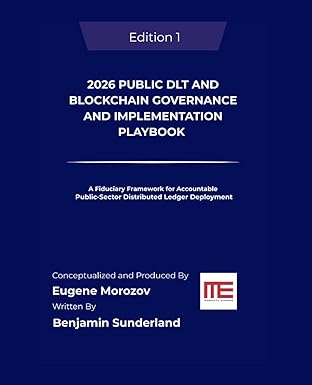

Paperback


A mandatory Non-Blockchain Alternative (NBA) establishes the fiduciary baseline and the standing rollback path. Blockchain systems are considered only after non-DLT alternatives are formally evaluated and documented. If a DLT deployment cannot demonstrably outperform the NBA on measurable outcomes, risk reduction, or resilience, the project must not proceed.
Gate-Based Lifecycle and Evidence Discipline
The PlayBook introduces a strict, gate-based lifecycle governing progression from pre-commitment through limited production and continuous operation. Each gate represents a binary Go / No-Go decision requiring documented evidence, accountable sign-off, and explicit authorization. Advancement is impossible without satisfying predefined governance, risk, and assurance criteria.
Strategic Context and Conclusion
The PlayBook is situated within a broader environment characterized by increasing fraud risk, declining public trust, and heightened scrutiny of automated and algorithmic systems. Within this context, distributed ledgers are framed not as solutions in search of problems, but as potential governance instruments whose legitimacy depends on evidence, discipline, and accountability.
The primary contribution of the 2026 PlayBook is constraint, not advocacy. It defines when blockchain systems may responsibly operate within public institutions—and when they must not. By prioritizing fiduciary duty, contestability, reversibility, cost discipline, and continuous assurance, the framework aligns distributed ledger decision-making with public-sector values, auditability requirements, and democratic oversight.

